
Get ready to roll into the world of Robot Rovers! In this behind-the-scenes look, we'll share how we brought this show to life from clunky beginnings to a pet-tastic adventure. CodeJoy’s Director of Learning, Amanda Jeane, sits down with Matt & Kelsey to find out all about Robot Rovers. Discover the unexpected inspiration that shaped our story and how we designed an experience that removes competition and sparks creativity for every student.
Amanda Jeane Strode (AJ): What is Robot Rovers?
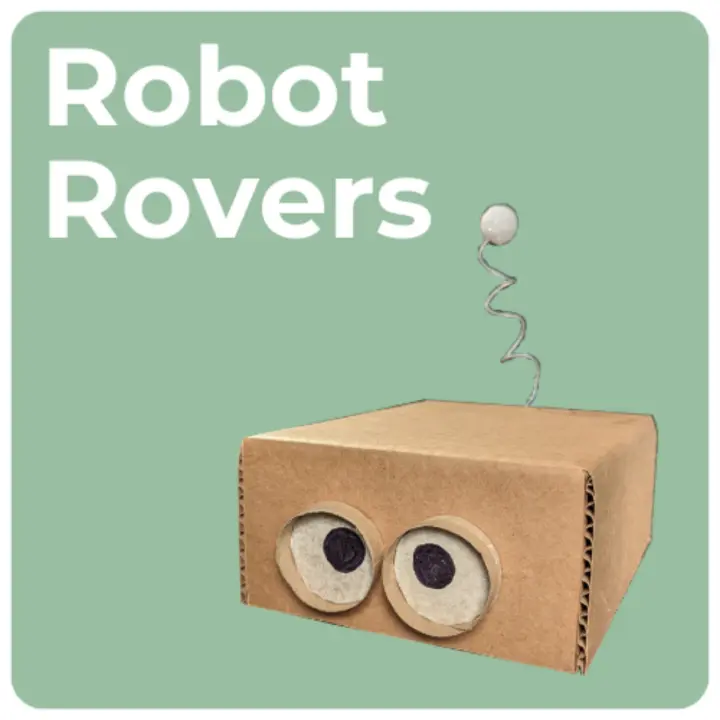
Kelsey Derringer (KD): Robot rovers is a story about Elby getting a brand new pet rover. That rover needs to be trained. So, the students learn to program servo motors in order to train the movements of this new pet rover. In doing so, they completely destroy Elby's little apartment and go on a field trip to the local rover park.
AJ: Where did the idea for Robot Rovers come from?
Matt Chilbert (MC): We had been trying to make a rover show for some time. After multiple iterations, we really hit a wall. The interactions weren't nearly as fun as we wanted them to be. The story was very clunky and lacked art. And it wasn't until we saw Carmen, she's a teacher in the Pittsburgh area, do a project using the Finch Robot, that we came up with the current interaction. Her project was designed to teach students about municipal services. She was putting boxes on top of Finch robots and making them into buses and snow plows and taxis. When we saw her do that everything sort of clicked and the current version of Robot Rovers came into focus.
KD: Not only was our first robot rover very finicky, but also, it really lacked a lot of heart. So, when we saw our friend Carmen turn Finches into school buses and ambulances it gave us just the right idea for the show. She had the kids navigate around little scaled down versions of their local communities. We thought, "That's great," because it lets the kids have design freedom over the exterior of that Finch Robot. When we rebuilt the show around a Finch covered up with a cardboard box, that made it a lot less finicky for the students to control and also creative control over the character design.
AJ: How did the plot for this show evolve over time?
KD: Originally the show was about transportation, but eventually it turned into a show about having a pet. The idea for transportation just didn't have any heart to it. When we transformed that rover from a car into basically a dog, the story just fell into place around it. There was a character that the audience could connect with. It was not a tool. It was an agent and that was a lot more fun to connect with.
MC: When Mike, our CTO, finally did eventually get the CodeJoy live system hooked up with a Finch Robot, we had to figure out how students could control that robot. The goal was for students to freely, live control this Finch robot in our studio. That was a great technical moment, but we still had a lot to work out in terms of what the story was going to be and how the interaction was going to work out. So, to help inform that, we let Mike's daughter, Penelope, who was about 7 years old at the time, play with the robot in our studio. We would just sort of set things up on the tabletop, let her kind of go through obstacles and interact with different things. And, as it turns out, what she really liked to do was destroy stuff. She wanted to knock stuff over. Watching us react to the destruction that she was causing was part of what was fun, too. I find that very relatable. So we decided to incorporate that into the story. The students, as they are training or programming the rover, they're naturally going to purposely, or on accident, bump into stuff and that stuff is going to topple over and make noise and create a mess.
AJ: When you designed this show, who was your audience? Who do you think naturally connects to this show?
MC: When we're designing a show, we're trying to connect with as many people as possible naturally. The only way typically to interact with rovers, at least that we've seen, is through competition. Lots of people and students design rover that have to be the fastest or the strongest in some way. And we really wanted to create something that removed the competition element, because that competition element is alone a barrier. Not all kids are interested in engaging in robotics through a competition. While trying to widen this door with this entryway to robotics through a rover, we thought the best way to do that would actually be through a lovable character that people would want to interact with. While not every kid has their favorite race car driver, most kids probably have a favorite animal or a beloved pet at home. So, we thought we'd connect to them through the things that they already love, which is animals.
AJ: Tell me more about how the students interact in this show.
MC: For the first part of the show, we teach students how to control rotation servos and they control how the rover’s right and left rotation servos independently. This allows the rover to move forward backwards, left or right, in any sort of crazy combination that they want to. Later in the show, we go to the dog park. The rover in our show is named “Fragile.” When we go to the dog park, they actually get to enter Fragile's point of view and control Fragile from the first person as they play fetch with Elby. Kelsey throws the stick for Elby and then they have to go search around this little rover park that we built and find that stick. 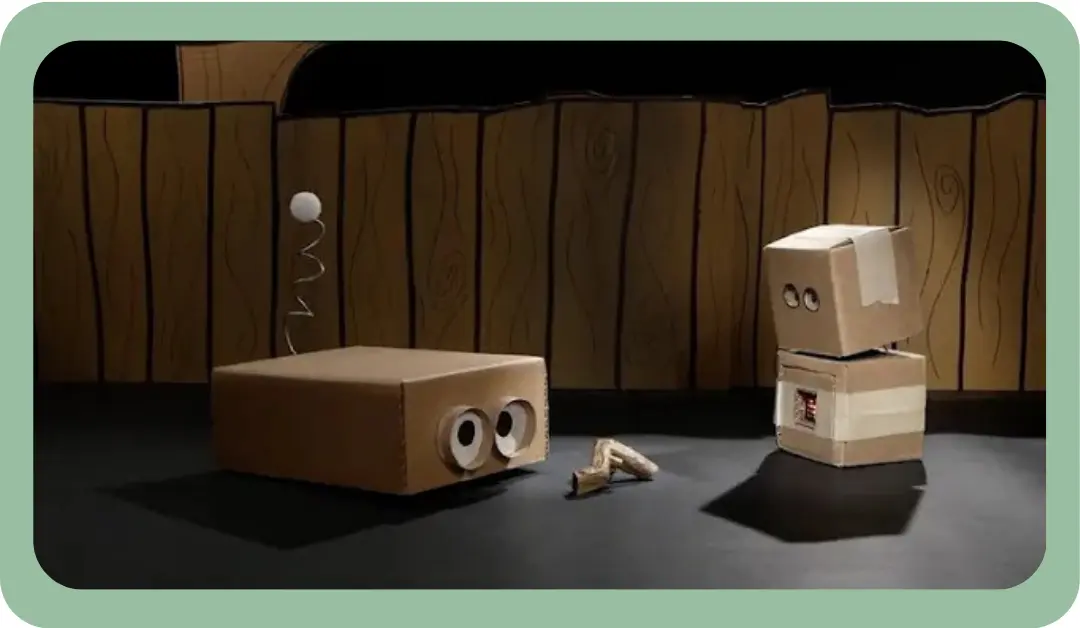 This allows for one of our most elaborate interactions where the students are actually using their keyboard to control the robot directly. It's always a lot of fun to see how excited they get when somebody from their class gets to essentially control the camera in our show.
KD: We've gotten reports back from teachers that when a kid in the class has control, the whole class roars .This is the equivalent of bringing a puppy into class except there's no allergens.
AJ: What can teachers do with rovers in their classroom?
KD: A lot of times when teachers would come to our professional development, they would see the Hummingbird robotics kit. One of their first questions would be, " Can I do a rover's unit? Can I make a rover?" And yes, you can make your own rover with a Hummingbird robotics kit. We have a pretty simple design to help out with that. However, a rover is a difficult introductory robot. Even when you make it with a Hummingbird, just getting the wheels to go at the same speed in the same direction takes a little more training than you might want it to for a first project. If you're going to do a rover as a first project, you should probably just use a Finch because it's a lot more accurate and easier to use.
Our student friendly lesson plan is essentially a simple rover that could be built with two rotation servos and a ping pong ball. It's extremely simple. We want to inspire kids to build rovers out of everyday, ordinary objects, like a shoe or a tissue box. There's a lot of places the teacher could take this afterwards. The goal is to take this rather complex project, a vehicle, and make it as simple as possible. And I think this design does that. The build should be relatively quick for most classrooms. We would expect the programming to actually take the majority of the time.
Want to bring Robot Rovers to your classroom? Check out our Robot Rovers page to find our Featured Project: _ PDF and Contact Us to start the discussion!
*Lesson plan to come! Still in production