

We’ve got a whole new world of Elizabethan drama, behind the wall and powered by robots and toilet paper tubes! We’re pulling back the curtain on “Robot Romeo,” our ridiculously fun, tech-infused puppet show that’s shaking up how we experience Shakespeare. Join us as Amanda Jeane chats with Kelsey and Matt, and discover how they’re making Shakespeare relatable, programmable, and downright hilarious for a new generation.
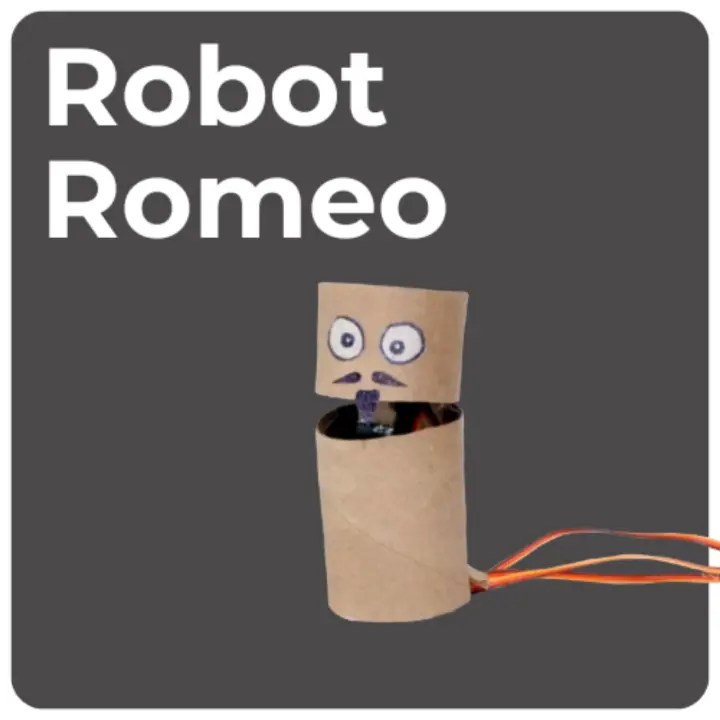
Amanda Jeane Strode (AJ): What is Robot Romeo?
Matt Chilbert (MC): Robot Romeo is an exploration of a scene in Romeo and Juliet. You can think of this as a deep textual reading of Romeo and Juliet disguised as a silly interactive puppet show with toilet paper tubes.
Kelsey Derringer (KD:) In our rendition of the classic Shakespearean play, students help determine what the characters might be feeling and then program micro:bit LEDs.
AJ: Where did the idea for Robot Romeo come from?
KD: Like all good ideas, it came from Shakespeare. It also came from the experience, probably many of us have had, trying to read Shakespeare as either a student or teach Shakespeare as a teacher. I think we’ve all felt a little lost in all those words. I had taught Romeo and Juliet as a high school teacher and found that the best way to teach it was to get the kids on their feet acting it out. And that worked really well for me because I’m a theatrical person. I was a theater minor in college and I performed Romeo and Juliet in high school, myself. I was Lady Capulet, by the way. No big deal.
 But, not every teacher is as dramatic as I am. Not every student group likes to get on their feet acting out a play. There’s lots of great ways to teach Shakespeare. A robot puppet show might be another one. This was our method of bringing Shakespeare to life and incorporating some technology education along with it.
Were you ever in Shakespeare, Matt?
MC: Yeah, I was a Young Siward in Macbeth. I didn’t have that many lines. Thankfully, I was out of the play very quickly.
AJ: Why Shakespeare?
KD: When we think about incorporating computer science and technology into other subject areas, we like to do what we call “educational yoga.” This is to take two things that seem really far apart and make them touch. So, what could be farther apart than a play written in the 1600s and a micro:bit invented in the 2000s? These things might actually be closer than teachers imagine. The micro:bit can really just be a simple way to explore whatever else you’re teaching. So, in this case, the emotions of the characters in the fight scene of Romeo and Juliet between Tybalt and Mercutio.
We also got a lot of inspiration from our friend Sue Melon, a teacher in the Pittsburgh region. She did a project called Robot Poetry. She was teaching a gifted and talented class and was trying to engage middle school boys in poetry, which is, as you might imagine, difficult. So, the way she did that was she had them create a robot poetry scene. They got to choose from a list of poems and then they had to bring that scene to life with motors, lights, and sensors. She tells a story about when this group of boys got up to present their final project. They had been arguing the entire week trying to put this thing together and then they got up in front of the class and one of the boys said, “The filament leaving the spider is like feelings leaving the soul.” And she tells this story that she was floored by that.
AJ: What was it like to integrate the technology into this show, particularly the use of micro:bit?
MC: The students are using the 5×5 LED panel on the front of the micro:bit to create expressions of emotions using symbols or sometimes words on the micro:bit itself. This is one of my favorite interactions because the kids can get very creative and put a lot of themselves into these characters. We actually ask them to play the Shakespeare characters. “What do you think Romeo is feeling in this moment?” We give him a little bit of background and then play the scene. Through this interaction, which feels kind of limited, a 5×5 LED screen, the kids can find a lot of ways to be expressive.
 The way that we bring that into the show is a little bit complicated. Everything in this show was shot beforehand. So, none of the robotics of Robot Romeo are live. What is live, however, are the images of the micro:bits that are floating above the character’s heads. These are the bits that show the students emotions. So, what we needed to do was find a clever way to get live bits showing what it is the students have coded into these recorded segments that we’ve shot, and we do that through some kind of clever compositing in OBS.
AJ: Tell me about the main characters of this show. What was the process and the decision making behind the robots.
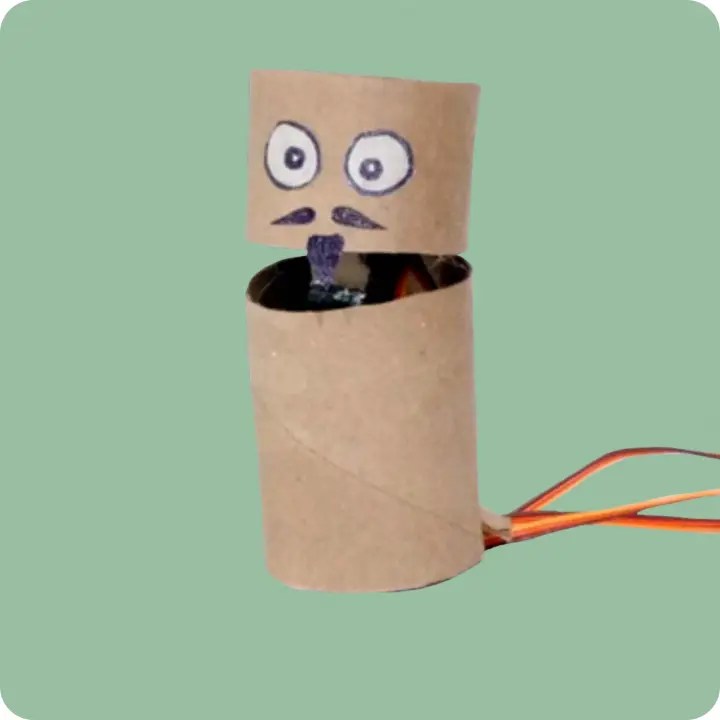
MC: Romeo, Tybalt, and Mercutio in this show are little toilet paper tubes. Their heads bob around. They do have two servos and an XY axis, not dissimilar from Elby. We realized that we could not make these characters look the same way as Elby, because we’ve already established that Elby, and the robots that are like him, do not talk. In order to make robots that spoke the English language, we wanted to create a completely different type of robot. So, we made these little toilet paper tube characters. Again, trying to stay true to one of our design principles, which is the students need to be able to see exactly how these are working and recognize the materials that create these robots. A toilet paper tube seemed like a very good way to convey those things.
KD: Part of the thinking behind the design of these characters was that they needed to be different from Elby because they have different vocal rules. To make the show easy for students to grasp, the only thing that should be new should be the motors or the micro:bit or something like that. The rest of it, we want it to be very apparent what recycled materials or accessible materials these are made out of. So, the toilet paper tube design was really smart. I really like how Matt designed these.
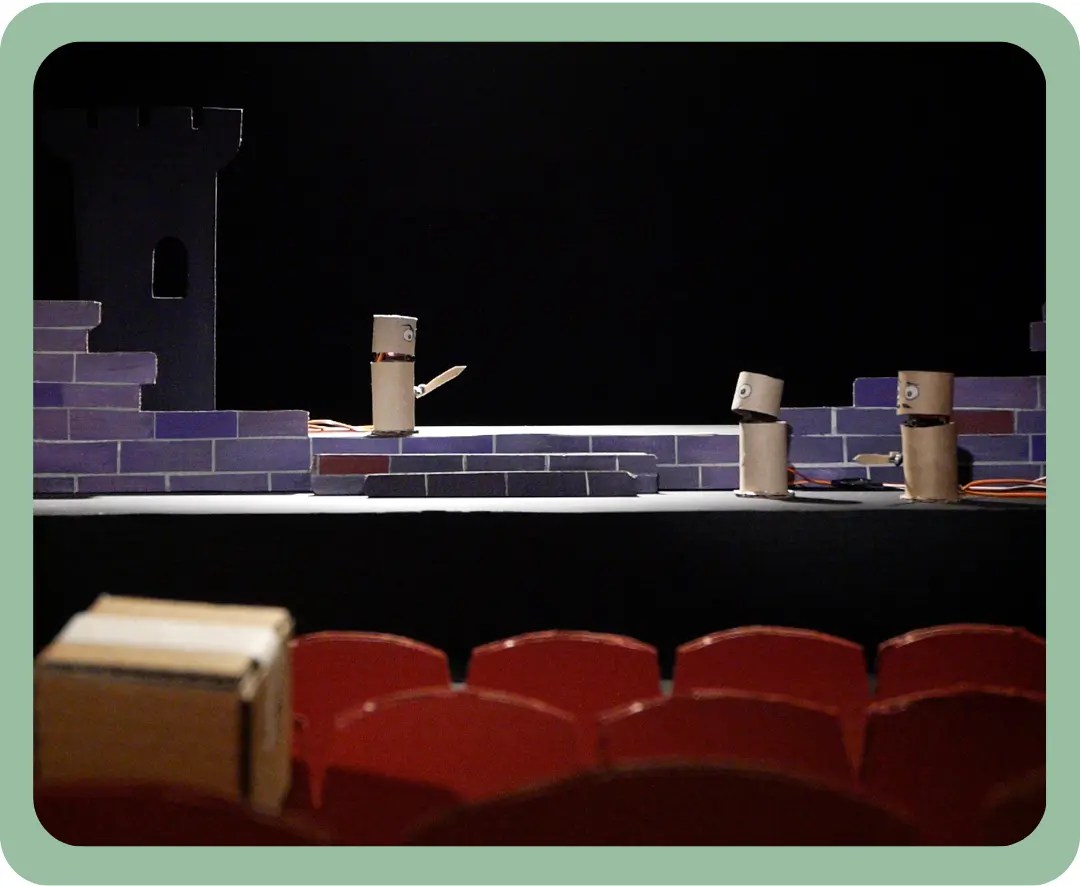
AJ: Tell me about the sword fight!
KD: Matt and I just played for an hour or more and just kind of let the camera roll and we were making the sound effects. It was just like kids playing! This scene was very play-oriented. I’m really glad that in the show itself you get some really nice close-ups of these characters because they’re so silly and funny. Another fun note about the sword fight is the voice actors for the extra characters. A couple of our good friends, Carl Smith, also known as Dr. Sparks, and Dave English, who’s a puppeteer friend of ours, helped us bring those characters to life. We got them to do the voice acting for us. We also needed that to be recorded because we knew that they wouldn’t be available for every single live show.
AJ: Is there anything else special about this show?
 KD: This show has a polling feature for the students. So, at one point, Mercutio and Tybalt are engaged in their epic sword battle and then we ask the students to vote for who they think is going to win. We don’t ask them who they want to win, but they always vote for Mercutio. It’s very sweet. Mercutio is awesome and everybody knows it. And, despite the fact that we introduced Tybalt as an excellent swordsman, the kids always think that Mercutio is going to win, and that is a bummer. But, it is a point of engagement because they can see this poll happening live on the screen. So, that was a new feature of CodeJoy live that we created for this show.
AJ: Where did the music from Robot Romeo come from?
MC: We thought the melodrama of “The Princess Bride” was a lot of fun. So, our music director, Bryce, we just gave him sort of clips from “The Princess Bride” and said, “Could you make music like this?” If that music sounds vaguely familiar, it’s lifted from the melodramatic tone of “The Princess Bride,” which is one of our favorite movies.
Want to bring Robot Romeo to your classroom? Check out our Robot Romeo page to find our Featured Project: _ PDF and Contact Us to start the discussion!
*lesson plan to come! Still in production
Leave a Reply